
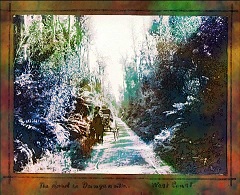
Marsden Road. Photo courtesy of History House, Greymouth. Digitally enhanced by G. Jonker
CHARLES MEEHAN
1837 – 1872
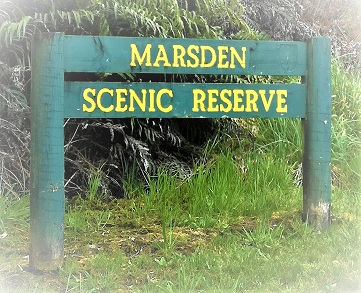
Photo taken by G Jonker
Marsden road was developed in 1873 from the run-down track that had been developed by Charles Meehan.
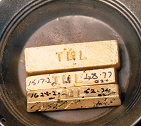
gold picture courtesy of History House, Greymouth
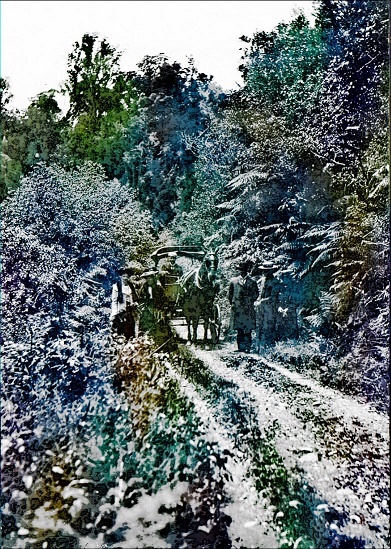
Horse and carriage with passengers on Marsden road. Picture courtesy of History House, Greymouth.
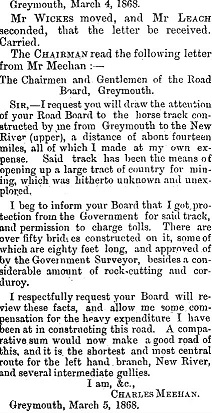
Clipping from Grey River Argus, Papers Past, 5 March, 1868.
Charles Meehan had vision and high hopes.
Charles could see the potential for a store to supply the diggers in the isolated and densly forested area of Welshman’s.
Reading the small pieces about his time living in Welshmans and Marsden that was reported in the Grey River Argus, Charles comes across as a man of pluck, vigour and honour.
He had strong beliefs, and high hopes.
The Grey River Argus, the Greymouth Newspaper of the time, has a court report of Charles being charged with selling ‘sly grog’ from his store.
He was found guilty for serving brandy. Even though the witness caught drinking said no money was involved, it was a shout, he was charged anyway.
In another report, where he was a witness, he said the amount of money owing was because of work not done.
He was a man who was upfront and expected the same.
On one occassion Charles spotted a bandit who was ready to steal his gold on the way to the Greymouth bank.
The would-be thief was armed and shot at Charles.
Charles managed to outrun him through the thick bush and lived to tell the tale, with his gold intact. (Adhead, Rona. Valley of Little Towms, 1988).
Charles was industrious.
The area of Welshman’s was isolated from Greymouth, so he cut a track.
He got permission from the Canterbury roading board who gave him ‘protection’ which should have guaranteed reimbursement.
Unfortunately, during the time of the track being cut there was a separation of districts, and now the roading in this area was under the West Coast authority.
When Charles asked for a reimbursement of 8oo pounds, in March 1868, for the expenses, (approximately $20,000 by todays standards), the Road Board would not honor it.
They turned down ‘Meehan’s Track’ as an official track into Greymouth and refused to reimburse him.
In 1869 he brought the matter to the council but again reimbursement was rejected.
Not only was Meehan out of pocket, all the residents also missed out on an easier route into Greymouth.
SHIPWRECKED
In May that year Charles Meehan declared bankruptcy and some time after that he left the West Coast of New Zealand and headed back to Australia.
Apparently, Charles signed up with the New Guinea Prospecting Expedition to explore the riches to be found in Papua New Guinea.
The ship that was chartered was a small old brig called the Maria. It had seen better days and only had enough lifeboats for the passengers.
The Maria was shipwrecked in February 1872.
The Argus reported the death by drowning of Charles Meehan who was apparently onboard this ship.
Some people survived the shipwreck, unfortunately some of these men were caught by aborigines on Northern Queensland and were killed and eaten.
In the account given by Rona Adshead in Valley of Little Towns, Meehan was one of the unfortunate victims of the indigenous aborigines.
One raft of seamen was helped by aborigines and survived.
In all the records I have been able to find there was no Charles Meehan on board the Maria.
There was a John Meehan, listed as an Able Seaman. This person stayed on board and would have died by drowning.
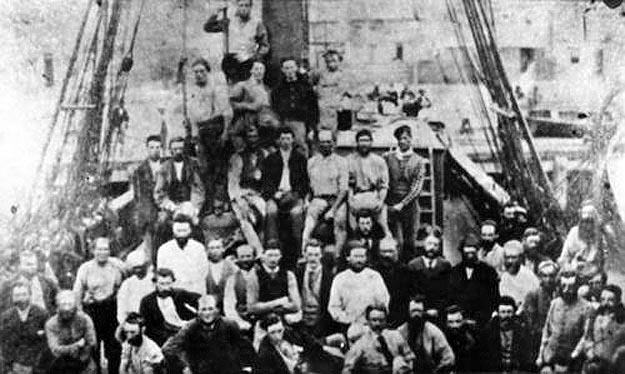
Passengers on the ‘Maria’. The ship was wrecked on Bramble Reef in 1872.
Wreck of the Brig Maria, by Miff Crommelin.
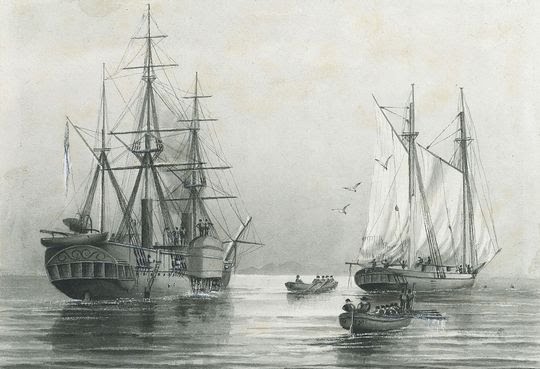
The ‘Basilisk’ stops to assist the last survivors aboard the derelict ‘Peri’
Wreck of the Brig Maria, by Miff Crommelin.
A sad ending to the story of a pioneer who never gave up.
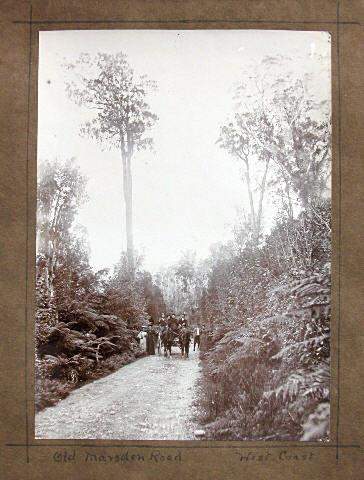
Horse and coach coming down Marsden Road which was the original Meehan’s track.
Photograph courtesy of History House, Greymouth.
MEEHAN’S TRACK DEVELOPED AND NAMED MARSDEN ROAD
In 1873, again, the need for another road from Marsden to Greymouth arose and was now considered an urgent priority.
The most suitable route was the Meehan track.
A road was developed using this track that went from Marsden to the outskirts of Greymouth through an inland route.
This route comes out in an area now known as Boddy Town (named after the Boddy family).
The road was known as the old Marsden road and is now the Marsden Road Reserve.
Meehan may never have known what became of his track after all his hard work and money (800 pounds back then was a substantial sum of money, $20,000 in today’s currency).
He had already left the area and was, it seems, was already dead.
CHARLES MEEHAN, store-keeper, prospector, miner and unnamed road developer.